Reinventing Technical Interviews in the Age of Artificial Intelligence

Reinventing Technical Interviews in the Age of Artificial Intelligence

In today’s world of distributed architectures, managing transactions that span multiple microservices is one of the greatest challenges. This is where the SAGA Pattern comes into play, a key solution for ensuring eventual consistency in distributed systems.

What is the SAGA Pattern?

The SAGA pattern is an approach for managing distributed transactions in microservices architectures. Instead of using a single transaction that locks resources across all the services involved, as in the traditional two-phase commit (2PC) approach, the SAGA pattern divides the transaction into a sequence of steps or subtransactions, each with a compensating action in case of failure.

What is Two-Phase Commit (2PC)?

Two-Phase Commit (2PC) is a protocol used to ensure strong consistency in distributed transactions. In 2PC, a transaction involving multiple nodes or services follows two phases:

  • Prepare phase: All participants receive a preparation request, and each responds if they can commit the changes or not.
  • Commit phase: If all participants are ready, a commit request is sent to confirm the changes. If any participant cannot complete the operation, a rollback is initiated to undo the changes. 2PC ensures strong consistency, but it can block resources for long periods, which is problematic in distributed systems requiring high availability and scalability.

How Does the SAGA Pattern Work?

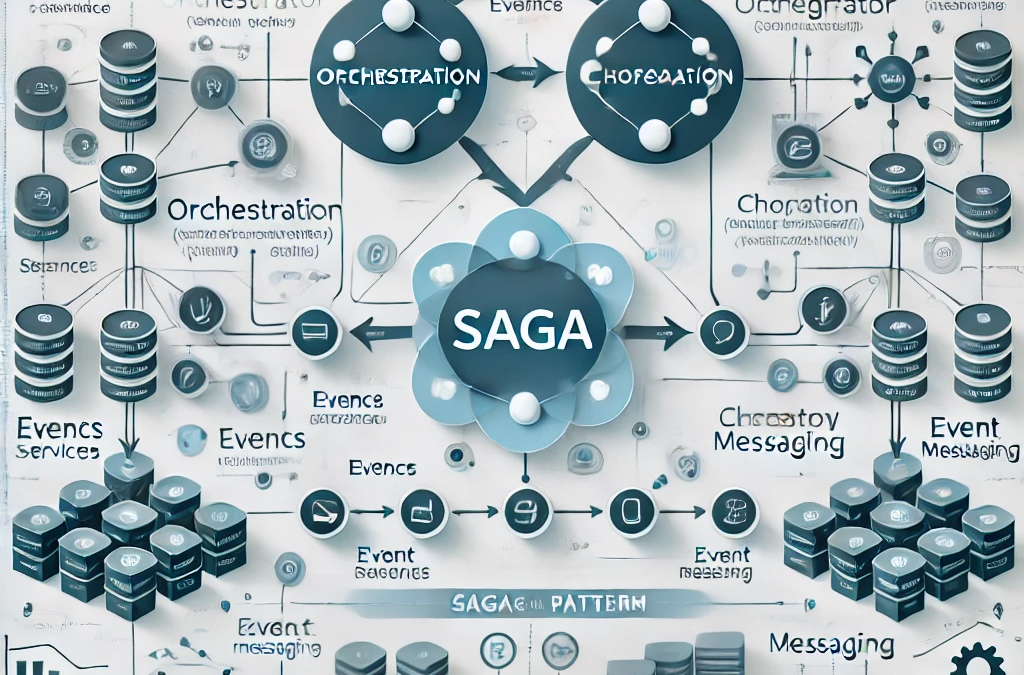
The SAGA pattern offers an alternative to 2PC by dividing a transaction into more manageable subtransactions, each with compensating actions for cases where a step fails. There are two main types of SAGA: Orchestration and Choreography, depending on whether the flow is centrally controlled or autonomously managed by each service.

Why Adopt the SAGA Pattern?

The main advantages of the SAGA pattern are:

  • Robustness: Improves the system’s ability to recover from failures, allowing for efficient compensations.
  • Scalability: Resources don’t need to be locked, allowing for greater scalability in independent microservices.
  • Decoupling: Enables services to operate autonomously, facilitating system evolution.

How to Implement the SAGA Pattern?

To implement Sagas:

  • Identify the microservices: Define the services that participate in the transaction.
  • Define subtransactions and compensations: Ensure each service has a compensating action.
  • Orchestration or Choreography: Choose the appropriate approach based on complexity.
  • Use frameworks: Tools can facilitate SAGA implementation.

Tools for Implementing the SAGA Pattern

There are many tools that simplify the implementation of Sagas in distributed architectures:

Libraries and Frameworks

  • Spring Boot
    • Spring Cloud Stream: Facilitates microservice integration with a choreography approach.
    • Spring Cloud Kafka Streams: Useful when using Kafka as a messaging system for Sagas.
  • Eventuate Tram: Provides a solid implementation of the SAGA pattern, supporting both orchestration and choreography.
  • Axon Framework: Known for Event Sourcing and CQRS, it is also ideal for implementing Sagas. Its event-based approach allows for smooth integration in distributed architectures.
  • Camunda: A process automation platform that manages workflows with BPMN, ideal for orchestration in Sagas.
  • Apache Camel: Offers a Saga component that facilitates the coordination of distributed microservices through messaging.

Cloud Services

  • AWS
    • AWS Step Functions: Ideal for distributed workflows, allowing the implementation of Sagas via orchestration.
    • Amazon SWF: Provides more control over the state of distributed transactions.
  • Azure
    • Azure Durable Functions: Allows writing stateful workflows in a serverless environment, ideal for Sagas.
    • Azure Logic Apps: Provides a visual interface for designing and automating workflows.
  • Google Cloud
    • Google Cloud Workflows: Allows for orchestrating services and APIs to implement Sagas.
    • Google Cloud Composer: Based on Apache Airflow, ideal for complex workflows.

Other Alternatives

  • MicroProfile LRA: Manages long-running transactions in microservices.
  • Temporal.io: Open-source platform for durable workflows.
  • NServiceBus Sagas: Part of the NServiceBus platform, specialized for .NET.

Considerations for Choosing Tools

When selecting a tool to implement Sagas, consider factors such as:

  • Technology stack: Choose tools compatible with the technology already in use.
  • Complexity: Tools like Axon Framework or Temporal.io are designed for more complex flows.
  • Infrastructure: Cloud options like AWS Step Functions offer managed solutions, while tools like Camunda provide more control on local servers.
  • Learning curve: Some platforms require more time to master but offer greater flexibility and control.

When Should You Use the SAGA Pattern?

Deciding when to use the SAGA pattern depends on the specific characteristics of the distributed system and the transaction requirements. SAGA is ideal for managing complex distributed transactions and ensuring availability and scalability without locking the resources of the involved microservices. Below are scenarios where the SAGA pattern is the best option and those where other alternatives may be more appropriate.

When to Use the SAGA Pattern

  • Long-running distributed transactions: In systems where transactions may span multiple services and must not lock resources for a long period, SAGA is essential. By dividing transactions into independent steps, resource blocking across multiple services is avoided, improving performance and scalability.
  • High fault tolerance: In environments where robustness is crucial, the SAGA pattern allows compensating actions in case of failures, ensuring the system quickly recovers without affecting global consistency.
  • Decoupled systems: In microservices architectures where services need to operate autonomously, choreography within the SAGA pattern allows services to interact via events, facilitating independent evolution.
  • Scalability: For systems requiring high scalability, the SAGA pattern is excellent, as it doesn’t rely on global transactions that block services, allowing each microservice to process its transactions independently.
  • Complex business processes: In scenarios where business rules span multiple services and require detailed control over transaction flow, the orchestration approach in SAGA provides a centralized view and facilitates error handling.

When Not to Use the SAGA Pattern

  • Short, low-risk transactions: If transactions are simple and don’t span multiple services, using SAGA may add unnecessary complexity. In such cases, it might be preferable to use a simpler approach, such as 2PC, which guarantees strong consistency without needing compensating actions.
  • Strict strong consistency requirements: If the system must ensure that all services involved in a transaction maintain a consistent state at all times, 2PC might be more appropriate. This is more common in systems where availability is not the main requirement and temporary resource blocking can be tolerated to ensure consistency.
  • Environments with low tolerance for transient failures: In some systems, intermittent or transient failures may be less frequent, and the need for a system that implements compensations might be overkill. In these cases, traditional transaction management may suffice.

Conclusion

The SAGA pattern is a powerful tool for managing distributed transactions in microservices architectures, providing robustness, scalability, and flexibility in environments where availability is critical. However, like any design pattern, its application depends on context. Using SAGA in scenarios where transactions are complex and distributed will improve fault recovery and overall system performance.

On the other hand, in environments where strong consistency is essential or transactions are simple and short-lived, traditional solutions like Two-Phase Commit (2PC) might be more appropriate. The key is to carefully evaluate the specific needs of the system before choosing the transaction management strategy that best suits the business and technical requirements

Reinventing Technical Interviews in the Age of Artificial Intelligence

Mastering the SAGA Design Pattern in Microservices Architectures

In today’s world of distributed architectures, managing transactions that span multiple microservices is one of the greatest challenges. This is where the SAGA Pattern comes into play, a key solution for ensuring eventual consistency in distributed systems.

What is the SAGA Pattern?

The SAGA pattern is an approach for managing distributed transactions in microservices architectures. Instead of using a single transaction that locks resources across all the services involved, as in the traditional two-phase commit (2PC) approach, the SAGA pattern divides the transaction into a sequence of steps or subtransactions, each with a compensating action in case of failure.

What is Two-Phase Commit (2PC)?

Two-Phase Commit (2PC) is a protocol used to ensure strong consistency in distributed transactions. In 2PC, a transaction involving multiple nodes or services follows two phases:

  • Prepare phase: All participants receive a preparation request, and each responds if they can commit the changes or not.
  • Commit phase: If all participants are ready, a commit request is sent to confirm the changes. If any participant cannot complete the operation, a rollback is initiated to undo the changes. 2PC ensures strong consistency, but it can block resources for long periods, which is problematic in distributed systems requiring high availability and scalability.

How Does the SAGA Pattern Work?

The SAGA pattern offers an alternative to 2PC by dividing a transaction into more manageable subtransactions, each with compensating actions for cases where a step fails. There are two main types of SAGA: Orchestration and Choreography, depending on whether the flow is centrally controlled or autonomously managed by each service.

Why Adopt the SAGA Pattern?

The main advantages of the SAGA pattern are:

  • Robustness: Improves the system’s ability to recover from failures, allowing for efficient compensations.
  • Scalability: Resources don’t need to be locked, allowing for greater scalability in independent microservices.
  • Decoupling: Enables services to operate autonomously, facilitating system evolution.

How to Implement the SAGA Pattern?

To implement Sagas:

  • Identify the microservices: Define the services that participate in the transaction.
  • Define subtransactions and compensations: Ensure each service has a compensating action.
  • Orchestration or Choreography: Choose the appropriate approach based on complexity.
  • Use frameworks: Tools can facilitate SAGA implementation.

Tools for Implementing the SAGA Pattern

There are many tools that simplify the implementation of Sagas in distributed architectures:

Libraries and Frameworks

  • Spring Boot
    • Spring Cloud Stream: Facilitates microservice integration with a choreography approach.
    • Spring Cloud Kafka Streams: Useful when using Kafka as a messaging system for Sagas.
  • Eventuate Tram: Provides a solid implementation of the SAGA pattern, supporting both orchestration and choreography.
  • Axon Framework: Known for Event Sourcing and CQRS, it is also ideal for implementing Sagas. Its event-based approach allows for smooth integration in distributed architectures.
  • Camunda: A process automation platform that manages workflows with BPMN, ideal for orchestration in Sagas.
  • Apache Camel: Offers a Saga component that facilitates the coordination of distributed microservices through messaging.

Cloud Services

  • AWS
    • AWS Step Functions: Ideal for distributed workflows, allowing the implementation of Sagas via orchestration.
    • Amazon SWF: Provides more control over the state of distributed transactions.
  • Azure
    • Azure Durable Functions: Allows writing stateful workflows in a serverless environment, ideal for Sagas.
    • Azure Logic Apps: Provides a visual interface for designing and automating workflows.
  • Google Cloud
    • Google Cloud Workflows: Allows for orchestrating services and APIs to implement Sagas.
    • Google Cloud Composer: Based on Apache Airflow, ideal for complex workflows.

Other Alternatives

  • MicroProfile LRA: Manages long-running transactions in microservices.
  • Temporal.io: Open-source platform for durable workflows.
  • NServiceBus Sagas: Part of the NServiceBus platform, specialized for .NET.

Considerations for Choosing Tools

When selecting a tool to implement Sagas, consider factors such as:

  • Technology stack: Choose tools compatible with the technology already in use.
  • Complexity: Tools like Axon Framework or Temporal.io are designed for more complex flows.
  • Infrastructure: Cloud options like AWS Step Functions offer managed solutions, while tools like Camunda provide more control on local servers.
  • Learning curve: Some platforms require more time to master but offer greater flexibility and control.

When Should You Use the SAGA Pattern?

Deciding when to use the SAGA pattern depends on the specific characteristics of the distributed system and the transaction requirements. SAGA is ideal for managing complex distributed transactions and ensuring availability and scalability without locking the resources of the involved microservices. Below are scenarios where the SAGA pattern is the best option and those where other alternatives may be more appropriate.

When to Use the SAGA Pattern

  • Long-running distributed transactions: In systems where transactions may span multiple services and must not lock resources for a long period, SAGA is essential. By dividing transactions into independent steps, resource blocking across multiple services is avoided, improving performance and scalability.
  • High fault tolerance: In environments where robustness is crucial, the SAGA pattern allows compensating actions in case of failures, ensuring the system quickly recovers without affecting global consistency.
  • Decoupled systems: In microservices architectures where services need to operate autonomously, choreography within the SAGA pattern allows services to interact via events, facilitating independent evolution.
  • Scalability: For systems requiring high scalability, the SAGA pattern is excellent, as it doesn’t rely on global transactions that block services, allowing each microservice to process its transactions independently.
  • Complex business processes: In scenarios where business rules span multiple services and require detailed control over transaction flow, the orchestration approach in SAGA provides a centralized view and facilitates error handling.

When Not to Use the SAGA Pattern

  • Short, low-risk transactions: If transactions are simple and don’t span multiple services, using SAGA may add unnecessary complexity. In such cases, it might be preferable to use a simpler approach, such as 2PC, which guarantees strong consistency without needing compensating actions.
  • Strict strong consistency requirements: If the system must ensure that all services involved in a transaction maintain a consistent state at all times, 2PC might be more appropriate. This is more common in systems where availability is not the main requirement and temporary resource blocking can be tolerated to ensure consistency.
  • Environments with low tolerance for transient failures: In some systems, intermittent or transient failures may be less frequent, and the need for a system that implements compensations might be overkill. In these cases, traditional transaction management may suffice.

Conclusion

The SAGA pattern is a powerful tool for managing distributed transactions in microservices architectures, providing robustness, scalability, and flexibility in environments where availability is critical. However, like any design pattern, its application depends on context. Using SAGA in scenarios where transactions are complex and distributed will improve fault recovery and overall system performance.

On the other hand, in environments where strong consistency is essential or transactions are simple and short-lived, traditional solutions like Two-Phase Commit (2PC) might be more appropriate. The key is to carefully evaluate the specific needs of the system before choosing the transaction management strategy that best suits the business and technical requirements

Circuit Breaker: The Pillar of Robustness in Modern Microservices Architectures

Circuit Breaker: The Pillar of Robustness in Modern Microservices Architectures

Nowadays, microservices architectures are increasingly common for building scalable, flexible, and autonomous systems. However, these benefits bring new challenges, especially in fault management. One of the most critical challenges is robustness, or the system’s ability to keep operating even when parts of it encounter issues. This is where the Circuit Breaker pattern becomes an essential tool.

What is the Circuit Breaker?

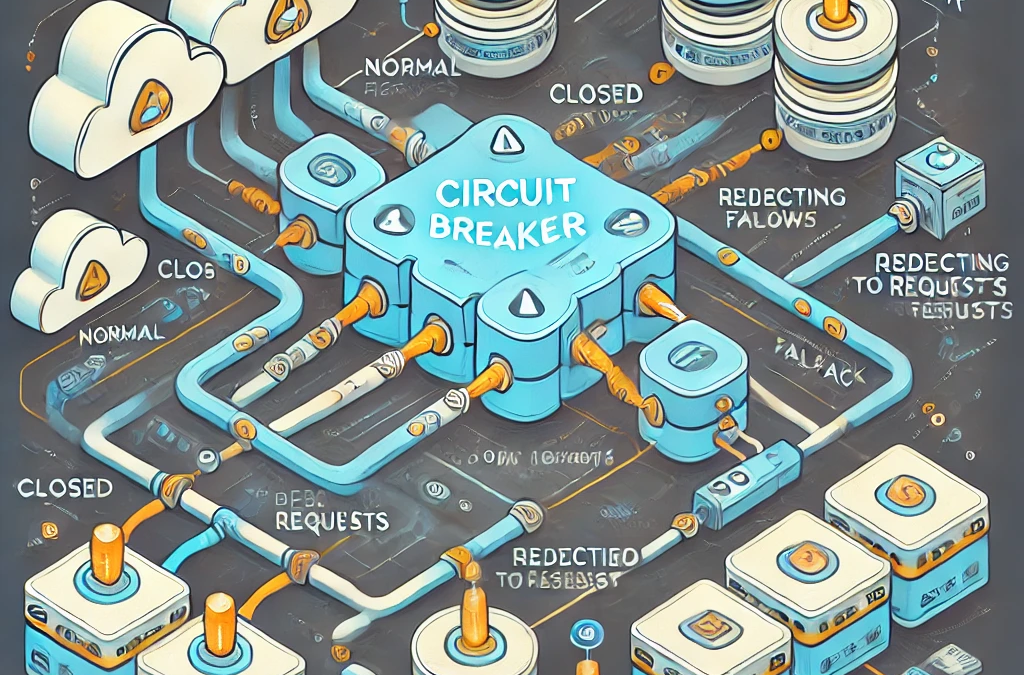
The Circuit Breaker, inspired by electrical switches that protect circuits from overloads, is a design pattern that acts as a gatekeeper in distributed architectures. Its role is to monitor interactions between microservices, preventing failures in one service from propagating to others. When a service begins to fail repeatedly, the Circuit Breaker “opens” the circuit and temporarily blocks requests to the problematic service, redirecting them to a fallback mechanism.

This mechanism is vital in distributed systems because microservices are vulnerable to a wide range of failures, from network issues to third-party service outages or request overloads. Without a proactive strategy to manage these failures, a small issue can quickly escalate into a cascading failure that affects the entire system.

Circuit Breaker States:

The Circuit Breaker has three main states that reflect the system’s behaviour:

  • Closed State (Normal Operation): In this state, the system is functioning correctly, and all requests pass through to the target service without interruptions. The Circuit Breaker monitors responses and, if it detects an increasing error rate, it may change state.
  • Open State (Failure Detected): If a service is detected as failing after reaching a predefined error threshold, the Circuit Breaker opens the circuit, blocking all requests to that service and redirecting them to a fallback response. This prevents the system from overloading a problematic service.
  • Half-Open State (Testing Mode): After a waiting period, the Circuit Breaker enters a half-open state where it allows a few requests to pass to the failed service to test if it has recovered. If the responses are successful, the circuit closes again; if not, the circuit reopens.

Each of these states enables efficient failure management, ensuring the system degrades in a controlled way rather than collapsing entirely.

Why Adopt the Circuit Breaker?

Adopting the Circuit Breaker is a strategic decision to improve robustness and stability in complex microservices systems. Key reasons to implement it include:

  • Prevention of cascading failures: In distributed systems, a failure in a single service can quickly spread to others if not properly managed. The Circuit Breaker prevents this by blocking requests to problematic services and allowing the system to degrade in a controlled manner.
  • Efficient resource management: When a service fails, continuing to access it only consumes resources unnecessarily and worsens the situation. The Circuit Breaker interrupts these requests, allowing system resources to be used more efficiently.
  • Improved user experience: Instead of allowing the system to fail entirely, the Circuit Breaker enables alternative responses (such as cached data or custom error messages), enhancing the user experience even in failure scenarios.
  • Reduced downtime: By proactively managing failures, the Circuit Breaker reduces system downtime, allowing development teams to focus on solving underlying problems without affecting end users.

How to Implement a Circuit Breaker?

There are multiple approaches and tools for implementing the Circuit Breaker pattern in a microservices system. The right approach depends on the existing architecture, the programming language used, and the available tools. Below are some of the most common options:

  • Circuit Breaker Libraries: Libraries are one of the most direct ways to implement a Circuit Breaker. Popular examples include Hystrix for Java, Polly for C#, and Resilience4j for Java. These libraries integrate directly into the microservices code and are used to manage calls to external services, implementing the Circuit Breaker logic around each request. This option is efficient when fine control over microservice interactions is needed.
  • Sidecar Pattern: In this approach, the Circuit Breaker is implemented in a separate process that accompanies each microservice, known as a sidecar. The sidecar manages all incoming and outgoing calls of the microservice, applying the Circuit Breaker logic without modifying the service’s code. This pattern is useful when language independence is required and simplifies the update and maintenance of the Circuit Breaker.
  • API Gateway with Circuit Breaker: In architectures using an API Gateway as the entry point for all microservices requests, the Circuit Breaker can be implemented at this layer. This allows centralized failure management and applying the Circuit Breaker globally to all microservices. This option is useful when a holistic view of the system’s state is required.
  • Service Mesh: Platforms like Istio or Linkerd provide a traffic management layer between microservices, where the Circuit Breaker can be one of the implemented policies. In this approach, each microservice has a proxy that manages requests, applying the Circuit Breaker logic as needed. This approach is ideal for systems requiring advanced communication management between services.
  • Microservices Frameworks: Some frameworks, such as Spring Cloud Circuit Breaker, offer integrated Circuit Breaker implementations. These frameworks allow configuring and managing Circuit Breakers directly from the microservice development environment, simplifying their implementation.

When to Use a Circuit Breaker?

The Circuit Breaker is particularly useful in scenarios where resilience and continuous availability are required:

  • Dependencies on external services: When microservices depend on external or third-party services that may not be fully reliable or have performance fluctuations.
  • Microservices with high load: In systems that process large volumes of requests, a failure in a service can quickly overload the system, making a Circuit Breaker crucial to prevent this.
  • High availability systems: When availability is critical, such as in e-commerce platforms or financial applications, the Circuit Breaker ensures system operation, even if parts of it fail.
  • Managed fault tolerance: In systems where a degraded response (such as cached data) is preferable to a complete outage, the Circuit Breaker efficiently manages these failures.

When Not to Use a Circuit Breaker?

Despite its benefits, there are situations where a Circuit Breaker may not be the best option:

  • Highly stable systems: If the microservices have consistent response times and rarely fail, introducing a Circuit Breaker could add unnecessary complexity.
  • Services that don’t require immediate fault tolerance: In systems where failures are acceptable, or where longer wait times don’t significantly impact the user experience, a Circuit Breaker may not be necessary.

Considerations for a Successful Implementation

For the Circuit Breaker to function correctly, it’s essential to consider several key aspects:

  • Threshold adjustments: Properly configuring failure thresholds and waiting times to ensure the Circuit Breaker is neither triggered unnecessarily nor insensitive to actual failures.
  • Continuous monitoring: Implementing a monitoring system to track Circuit Breaker behavior and adjust its configuration as needed.
  • Consistency in implementation: Ensuring all microservices follow a consistent Circuit Breaker implementation strategy to avoid inconsistencies that could negatively impact the system.
  • Exhaustive testing: Testing Circuit Breaker behavior under different load and failure conditions is crucial to ensure it works properly in real scenarios.

Conclusion

The Circuit Breaker is an indispensable tool for ensuring resilience and stability in distributed systems. Its ability to manage failures proactively prevents problems from spreading throughout the system, ensuring services continue to operate even in adverse situations. Effectively adopting and implementing this pattern improves user experience, optimizes resource management, and contributes to the platform’s operational continuity.

API Gateway: A Key Pillar in Modern Microservices Architecture

API Gateway: A Key Pillar in Modern Microservices Architecture

In an environment where microservices-based architectures have revolutionized software development, the API Gateway has evolved from an optional tool to an essential component for ensuring the efficiency, security, and performance of modern applications. Increasingly, organizations are adopting microservices due to their scalability and modularity. In this context, the API Gateway plays a crucial role as a centralized control point for traffic between users and backend services.

What is an API Gateway?

An API Gateway acts as a single-entry point for client requests to backend services. It processes all incoming requests, directing them to the appropriate service, transforming data when necessary, and applying centralized security policies. It is an intermediary that not only improves communication between clients (such as mobile apps, web apps, IoT devices) and services but also provides an abstraction layer that simplifies interaction between software components.

The main functions of an API Gateway include:

  • Routing: Redirects traffic to the corresponding microservices, facilitating communication between different services.
  • Response aggregation: Consolidates responses from multiple microservices into a single response, improving efficiency for the client.
  • Authentication and authorization: Centralizes security by verifying user identities and managing their permissions.
  • Protocol transformation: Facilitates the conversion of protocols, such as from REST to gRPC, adapting communication formats between clients and backend services.
  • Caching: Reduces backend service load by caching frequent responses, significantly improving performance.
  • Monitoring and analysis: Provides visibility into service traffic and performance, allowing metrics and logs to be collected for system supervision.
  • Rate limiting: Sets limits to control the number of requests a client can make to the API, protecting backend services from overload.
  • Error management: Offers a centralized way to handle and report errors, ensuring a consistent user experience.

When to use an API Gateway?

Implementing an API Gateway in a microservices architecture offers numerous benefits, but it’s not always the right solution for every scenario. Here’s a guide on when it’s beneficial to adopt an API Gateway and when it might not be necessary.

Use an API Gateway in these scenarios:

  • Microservices architecture: When managing a set of backend services, providing a unified entry point is essential.
  • Multiple client types: If APIs are consumed by various clients (web, mobile, IoT) that require different data formats or transformations.
  • Complex security requirements: Ideal when centralized authentication and authorization implementation is needed.
  • High traffic: If managing a system with heavy traffic, the API Gateway can improve performance through caching and response aggregation.
  • Detailed analytics: When detailed API usage monitoring and advanced metrics are required for analysis.
  • Multiple API versions: Useful when maintaining different versions without affecting existing clients.
  • Complex data transformations: If data needs to be transformed from multiple services before being sent to the client.

Do not use an API Gateway in these cases:

  • Monolithic applications: If there is no subdivision into microservices, a centralized entry point is unnecessary.
  • Single client type: When only one client exists (e.g., a web application) with no plans to expand into other formats.
  • Simple security requirements: If backend services can handle basic security needs directly.
  • Low traffic: For applications with low traffic volume, the overhead of managing an API Gateway may not be justified.
  • Basic monitoring: If only simple logs are required, backend services can manage them without a Gateway.
  • Stable API: If the API does not need versioning or major future changes.
  • Minimal data transformations: If data can be consumed directly without complex transformations.

How to Implement an API Gateway? Approaches and Tools

The implementation of an API Gateway can be done in several ways, depending on the project’s needs, available resources, and existing infrastructure. Below are the most common approaches:

Using existing solutions

Many commercial and open-source solutions are specifically designed as API Gateways. Notable examples include:

  • Kong: An open-source solution with a solid plugin ecosystem, allowing for great customization and flexibility.
  • Apigee: A Google product focused on enterprise API management, offering an intuitive interface and robust support.
  • Tyk: Another open-source option that provides a high-performance API Gateway, easy to scale.

Advantages: These platforms offer a wide range of features, enterprise support, and a mature plugin ecosystem that facilitates customization.

Disadvantages: They can be complex to configure, and in the case of commercial options, may incur licensing costs.

Using frameworks and libraries

Some teams choose to integrate frameworks within their development ecosystem instead of using a complete third-party solution. Examples include:

  • Spring Cloud Gateway (Java): Ideal for those already working with the Spring ecosystem, providing seamless integration with other Spring tools.
  • Express Gateway (Node.js): Lightweight and easy to use, especially for teams working with Node.js.

Advantages: They offer flexibility, allowing the API Gateway’s functionalities to be customized according to the project’s specific needs.

Disadvantages: They require more development and maintenance, which can increase implementation time and resource requirements.

Custom implementation

Another option is to create a custom API Gateway, developing a microservice that acts as the centralized entry point. This approach offers the most control over the functionalities and allows them to be tailored exactly to the system’s needs.

Advantages: Provides complete control over functionality, allowing the API Gateway to be adapted to unique and specific use cases.

Disadvantages: Requires a greater investment in development time and continuous maintenance efforts.

Managed cloud services

For those operating in the cloud, providers like AWS, Google Cloud, and Azure offer managed API Gateway services, such as AWS API Gateway or Azure API Management. These solutions are deeply integrated with other cloud services, making scalability and integration easier.

Advantages: They offer automatic scalability, integration with other cloud services, and require less maintenance effort.

Disadvantages: They may generate vendor lock-in and provide less control over the underlying infrastructure.

Conclusion

The API Gateway is an essential component for managing the complexity of modern systems based on microservices. From improving security to optimizing performance and facilitating scalability, its adoption has become key in advanced architectures. Whether choosing a commercial solution, a framework, or a custom implementation, success depends on carefully evaluating the project’s needs and the development team’s capabilities.

Serverless: Transforming Software Architecture

Serverless: Transforming Software Architecture

In the age of digital transformation, companies are constantly looking for ways to increase efficiency and reduce costs without compromising their ability to scale operations. One of the technologies leading this change is Serverless. This architectural model has gained momentum in modern software development due to its ability to simplify development, reduce costs, and improve operational efficiency. But what exactly is serverless, why has it gained so much popularity, and how can it benefit your organization?

What is Serverless?

The term serverless can be misleading. It doesn’t imply the absence of servers but rather that they are fully managed by a cloud provider. In traditional architecture, developers have to worry about provisioning, scaling, updating, and maintaining servers. With serverless, that responsibility falls on the cloud provider, allowing developers to focus solely on writing and deploying code.

Function as a Service (FaaS) is the central pillar of serverless, where developers write small functions that are executed only when an event occurs, such as an HTTP request or the arrival of a file in a storage system. Users don’t have to worry about the complexities of infrastructure, such as scaling or server availability, as all of that is managed by the provider.

Some popular examples of serverless technologies are:

  • Amazon Web Services (AWS) Lambda
  • Microsoft Azure Functions
  • Google Cloud Functions

Why Use Serverless?

– Automatic and Flexible Scalability

One of the main attractions of serverless architecture is its ability to scale automatically. There’s no need to provision or manually adjust server capacity; the cloud provider automatically scales resources according to demand. This means that if your application experiences an unexpected traffic surge, you won’t have to worry about servers being overwhelmed or crashing, as the infrastructure adapts in real time to the load.

– Reduced Costs

In traditional architectures, you tend to pay for maximum server capacity, regardless of whether it’s fully utilized. With serverless, you only pay for the runtime of the functions, leading to significant cost efficiency. If the function isn’t running, you’re not paying. This can result in enormous savings, especially for applications that don’t have constant demand.

– Simplified and Agile Development

 Serverless allows development teams to focus on what really matters: building features. By eliminating the need to manage infrastructure, developers can launch new features and updates faster. This facilitates a more agile and iterative development cycle, which is ideal for startups or teams working under agile methodologies.

– Improved Operational Efficiency

With serverless architecture, there’s no need to worry about infrastructure maintenance, such as server upgrades, security patches, or network management. This reduces the load on operations teams, allowing them to focus on more strategic tasks rather than infrastructure maintenance.

Who Is Serverless For?

While serverless has many advantages, it’s particularly useful for certain types of organizations and use cases:

– Startups and SMEs

Startups and small businesses can benefit greatly from serverless architecture. Often, these organizations have limited resources and need to maximize the efficiency of their developments. Serverless allows them to focus on building their products without worrying about infrastructure complexity. Additionally, since they only pay for the actual use of resources, they don’t need to make large initial investments in servers or infrastructure.

– Event-Based Applications

 Serverless is ideal for applications that rely on events, such as IoT applications, real-time streaming platforms, or data analysis tools that process large volumes of information in real-time. For example, in a scenario where large amounts of data are received from IoT sensors, serverless’ automatic scalability ensures that the infrastructure can handle the load smoothly.

– Systems with Traffic Fluctuations

 Many applications have traffic that varies significantly based on external events or marketing campaigns. E-commerce websites often experience traffic spikes during sales seasons or events like Black Friday. With serverless, the infrastructure effortlessly scales with demand and then scales down once traffic decreases, avoiding unnecessary costs.

– Short-Term Projects or Prototypes

 Serverless is also useful for projects with a limited lifecycle, such as prototypes or proofs of concept (PoCs). In these cases, serverless’ cost and operational simplicity are ideal, as it allows projects to get started without committing to large infrastructures or long-term server contracts.

How to Implement a Serverless Architecture?

Although it may seem like an advanced approach, implementing serverless is quite straightforward if you follow an organized process. Here are the essential steps:

– Select a Cloud Provider

The first step is to select the right provider. AWS Lambda, Azure Functions, and Google Cloud Functions are the most popular options. Each offers different levels of integration with other cloud services, so the choice should be based on the current ecosystem, preferences, and specific needs.

– Define the Functions

Serverless applications are composed of small functions that perform specific tasks. Each function should be modular and handle a single responsibility. For example, one function could handle user authentication, while another processes a payment request.

– Configure Triggering Events

 One of the most powerful features of serverless is its ability to react to events. Events can be HTTP requests, the arrival of a file in a storage bucket, database changes, or messages in a message queue. Properly configuring these events is key to ensuring that functions only run when necessary.

– Secure and Configure Permissions

Although serverless abstracts much of the infrastructure, security remains crucial. Properly configure permissions so that functions only access the resources they need, using managed services like AWS IAM or Azure Active Directory to handle authentication and authorization.

– Monitoring and Continuous Optimization

Monitoring is key to ensuring that functions run optimally. Services like AWS CloudWatch or Google Cloud Monitoring allow real-time metrics tracking, identifying bottlenecks, and optimizing resource usage.

Considerations When Using Serverless

While serverless has many advantages, there are also some important considerations. Cold start can be a challenge, as when functions haven’t run in a while, there can be a small initial delay. It’s also crucial to manage dependencies and execution times well, as serverless functions often have limits on the allowed runtime.

Conclusion

Serverless architecture offers a powerful solution for building modern applications that automatically scale, reduce costs, and simplify operational management. From startups to large corporations, serverless is an option that allows companies to innovate faster, respond efficiently to customer demand, and optimize their operations. By focusing on writing code and letting the cloud provider handle the rest, organizations can free up resources and time to drive growth